
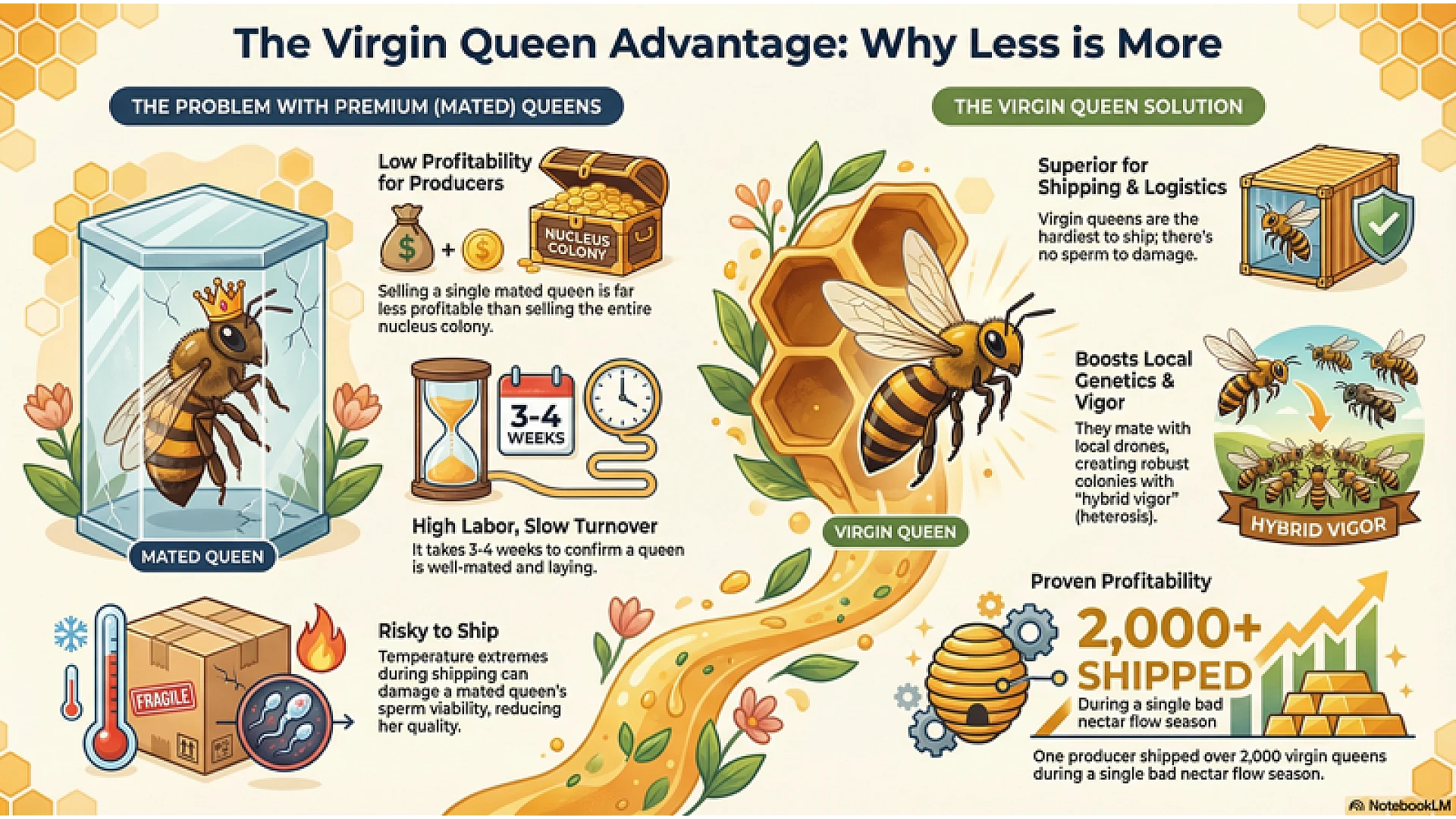
In this presentation, Cory Stevens discusses the financial and logistical advantages of producing and utilizing virgin honeybee queens. He explains that selling virgin queens is more profitable than producing mated queens or nucleus colonies because it significantly reduces labor and time costs. To ensure success, Stevens details his specific "Stevens method" for introduction, which involves making colonies "hopelessly queenless" to increase acceptance rates. He also emphasizes the importance of quality control, such as incubating cells and hand-watering emerging queens to ensure they remain healthy during transport. Furthermore, the source highlights the genetic benefits of using virgin queens, noting that they offer a hardy, cost-effective way to distribute specific traits like Varroa Sensitive Hygiene (VSH). Ultimately, the speaker encourages beekeepers to move beyond traditional expectations to improve their operational efficiency.
Source: https://www.youtube.com/watch?v=rmskzuC42Bw
Queen Type | Advantage/Trait | Cost or Value | Timeframe for Development/Release | Introduction Success Method | Logistical Consideration | Management Recommendation | Source |
|---|---|---|---|---|---|---|---|
Virgin Queens | Logistical hardiness; superior for shipping (no sperm damage); ideal for genetic injection (VSH traits); labor and time saving compared to nucleus colonies. | - USD each | Shipped Next Day Air; emerge approx. day 15-16; can be held in incubator or banked up to 3.5 weeks. | Use 'Stevens method' or ensure colony is 'hopelessly queenless' (split 7-8 days in advance so no larvae of appropriate age exist). | Hardiest type to ship; guaranteed live delivery; not affected by temperature extremes that damage sperm viability. | Water 1-2 times daily using finger droplet method; avoid getting water in candy; use dry candy consistency if incubator humidity is high. | [1] |
Queen Cells | Low labor; allows for genetic injection into apiaries; efficient for large-scale operations. | USD each | Pulled 7 days after grafting; 10-day cells (ripe); fragile during shipping. | Introduced to splits; high success rate if cells are pre-inspected for viability. | Extremely sensitive to shipping delays; cells usually die if delivery is missed by one day. | Peek into cells (break wax cup) to check for 6 legs, wings, and vitality before using or selling. | [1] |
Inseminated Queens (Breeder Queens) | Paternal and maternal lines controlled; used for specific breeding programs (VSH). | Not in source | Ideally inseminated on day 10. | Hopelessly queenless method; use push-in cages; release once sperm migration is complete. | Extremely difficult to introduce; highest risk of being killed by workers if natural cells are present. | Ensure colony is queenless for 7+ days with no young larvae; remove all emergency cells before release. | [1] |
Mated Queens | Premium product; provides full pheromone profile that suppresses worker ovaries and queen cell building. | USD (historical pricing) | Minimum 3-4 weeks in a nucleus colony to verify brood pattern and full pheromone development. | Often direct released or candy released; pheromones help suppression, though cells may still be built. | Sensitive to temperature extremes during shipping which can damage sperm viability in the spermatheca. | Best left in nucleus colonies for a full 3 weeks to ensure high quality and full pheromone maturity. | [1] |